Nazeri Architects
Designing for confidence before contact
PROJECT SUMMARY
How personalized user paths transformed an anxiety-inducing website into a self-service trust engine
TIMELINE
MY ROLE
I owned the full UX strategy and design direction — from reframing the site's structure around personalized paths to high-fidelity mockups — using the firm's existing brand and portfolio as constraints.
TOOLS
Framer
Figma
Miro
Notion
2 min read
CONTEXT
Local architecture studio in Walnut Creek, CA are losing potential clients not because of bad work, but because their websites push visitors to commit before they understand anything.
Post-pandemic homeowners and small business owners are doing more independent research before any service engagement — they expect digital self-service.
At stake: qualified leads the firm never knew it was losing, and users who left with more anxiety than they arrived with.
PERSONA
Who are we designing for?

Jessie, 43
M.D. at Stanford Health
"I want to understand what I’m getting into before I talk to anyone."
Jessie is a new homeowner planning a remodel, who needs clear, transparent, self-service information about an architectural firm’s process, scope, and credibility so she can confidently evaluate options and understand what to expect before reaching out.

Harry, 61
Cafe owner
"I want to know upfront if this firm understands commercial spaces. I don’t have time to figure out the process as I go.”
Harry is a café owner opening a new location who needs a fast, reliable architectural professional with clear communication and proven commercial execution so he can deliver a high-quality space on time and keep his business moving.
PAIN POINTS
No way to understand the process without contacting first
She needs to know steps, costs, and timelines before she's ready to talk to anyone.
No way to evaluate if the firm is trustworthy
Images alone don't build confidence. Without project context or client stories, she has no evidence to make a decision.
He can't tell if the firm works fast enough
The site shows pretty projects, not timelines or commercial experience.
He can't afford surprises
No upfront scope or costs means too much risk for a business on a deadline.
COMPETITIVE ANALYSIS
Local architecture websites fall into two traps:
- large firms like Gensler are structured but cold and overwhelming;
- small local firms feel personal but offer images with no context, no process, and a "Contact Us" button as the only next step. Neither serves a user who's still deciding.
A few gaps were found to exploit, which lead us to new opportunities:
from
GAP
to
OPPORTUNITY
Process is never explained
Simple "How It Works" with phases and timelines
All visitors get the same experience
Separate paths for homeowners and business owners
No trust signals
Testimonials, team profiles, project narratives
No communication clarity
Upfront info on response times and collaboration style
CHALLENGE
Redesign the Nazeri Architects website to help two different types of clients — homeowners and business owners — understand the firm's process, evaluate their fit, and feel confident enough to reach out, without being pushed to contact before they're ready.
TENSION
What made it hard:
Two users (Jessie and Harry) had fundamentally opposing relationships with time and trust — one needed emotional reassurance, the other needed operational efficiency.
The firm wanted to appeal to both residential and commercial clients without diluting the brand.
No existing metrics, no analytics — research had to be entirely qualitative.
The pivot:
Early instinct was to redesign the homepage as a single stronger hero — more polish, cleaner navigation,
But research revealed the real problem wasn't aesthetics: it was that all users landed in the same undifferentiated experience.
Pivot: Shifted from "better-looking website" to "personalized entry paths" — a more structural, strategic solution.
How pivoting impacted design: Once I committed to segmented paths, every page had to serve one of two clearly defined user intents.
CONSTRAINTS
One brand, two audiences
The site had to serve both homeowners and business owners without splitting into two separate websites or diluting the firm's identity.
No user data to validate decisions
There were no analytics or existing research to draw from. Every design decision was grounded in qualitative research and competitive analysis alone.
DESIGN STRATEGY
The strategic shift from "Contact First" → "Educate First".
The decision to create two distinct entry paths: Homeowners vs. Business Owners.
Segmentation reduces cognitive load and increases trust.
JUDGEMENT
The most important decision was to stop treating Contact Us as the goal.
Premature contact was the conversion killer. Reframing the entire site around education before action changed every subsequent decision — what the navigation prioritized, how project pages were structured, and what contact felt like.
SOLUTION
DISCLAIMER:
This project is a conceptual UX/UI redesign created for educational and portfolio purposes.
It is not affiliated with or commissioned by NAZERI Architects.
All original content and brand assets belong to their respective owners.
1
Home page update
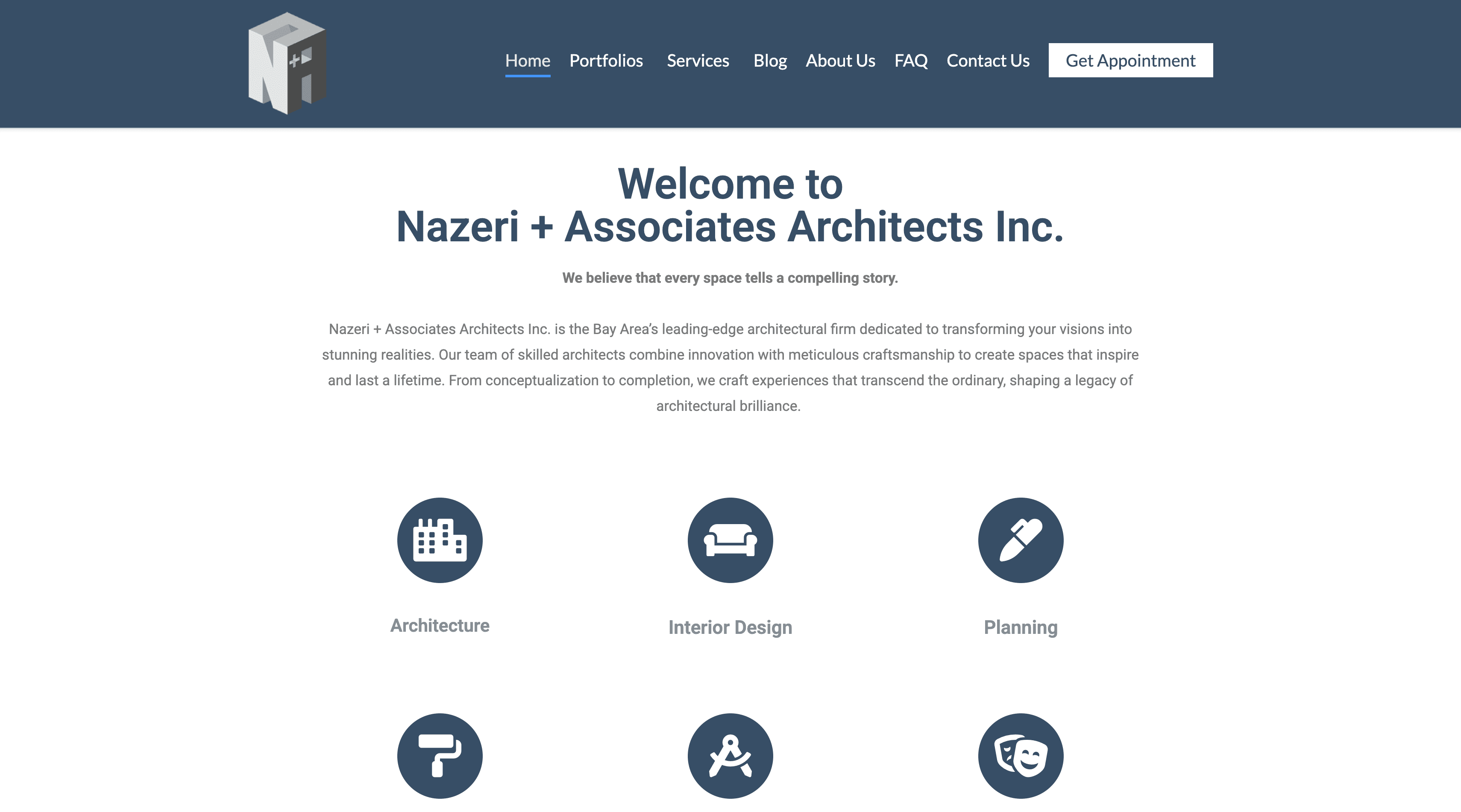
After
Two explicit paths — Residential and Commercial — let users self-select immediately. The site now speaks to who they are, not just what the firm does.
Before
Generic hero, no entry points. Everyone lands in the same experience with no clear next step.
2
Before
No process explanation existed. Understanding the steps required contacting the firm first.
After
Each phase now has a name, duration, and deliverables. FAQs answer the questions users had before they were ready to call.
3
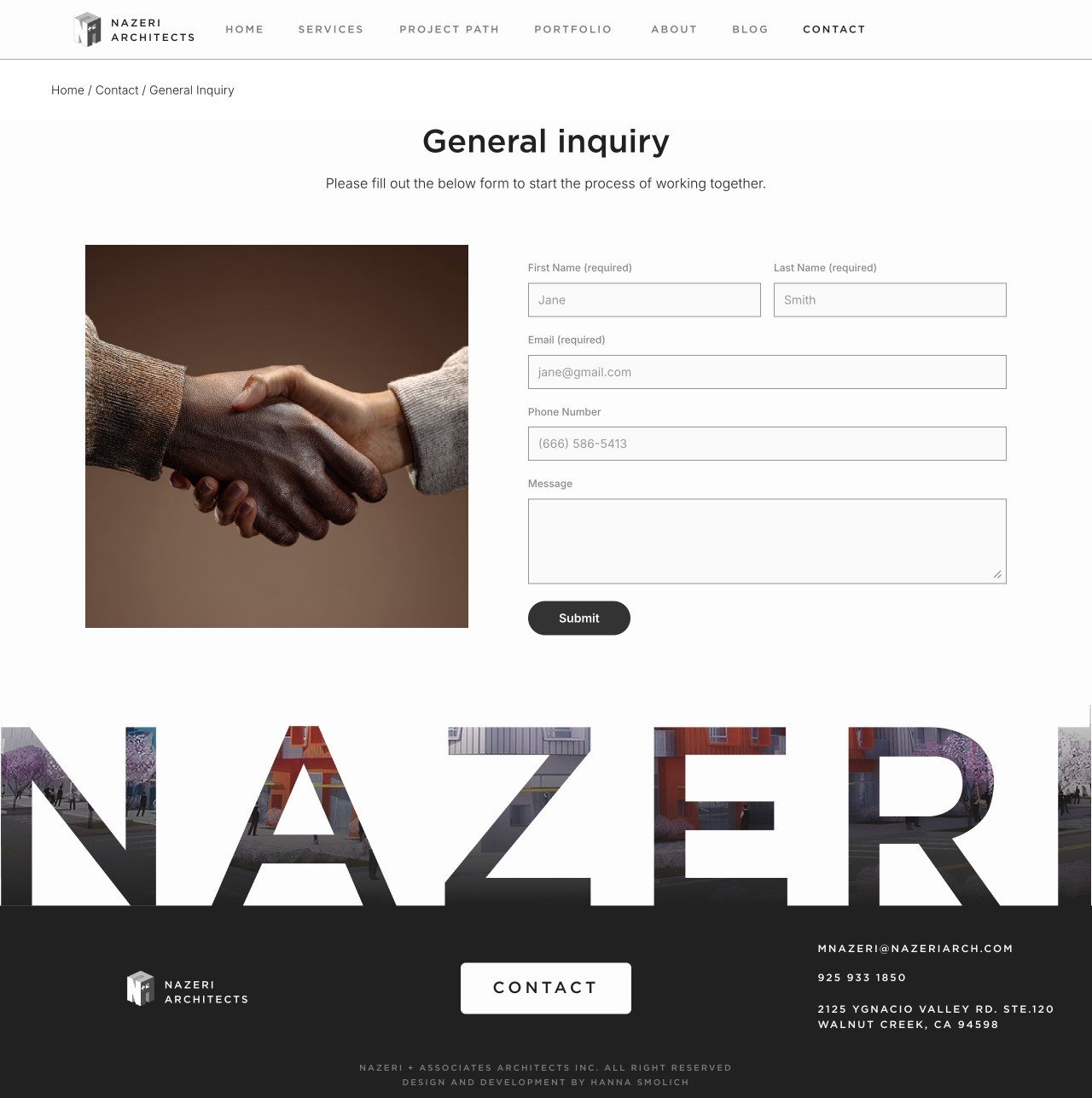
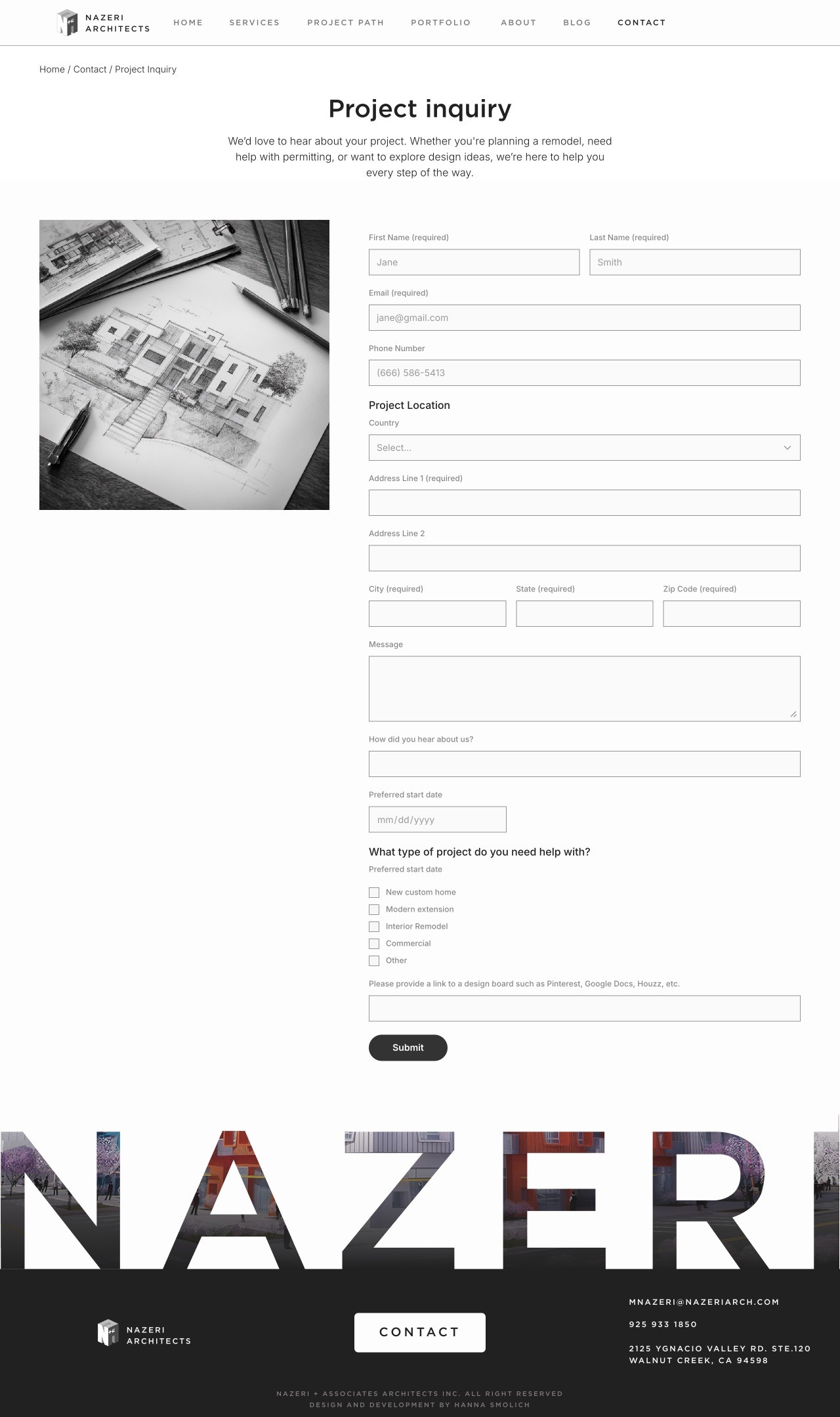
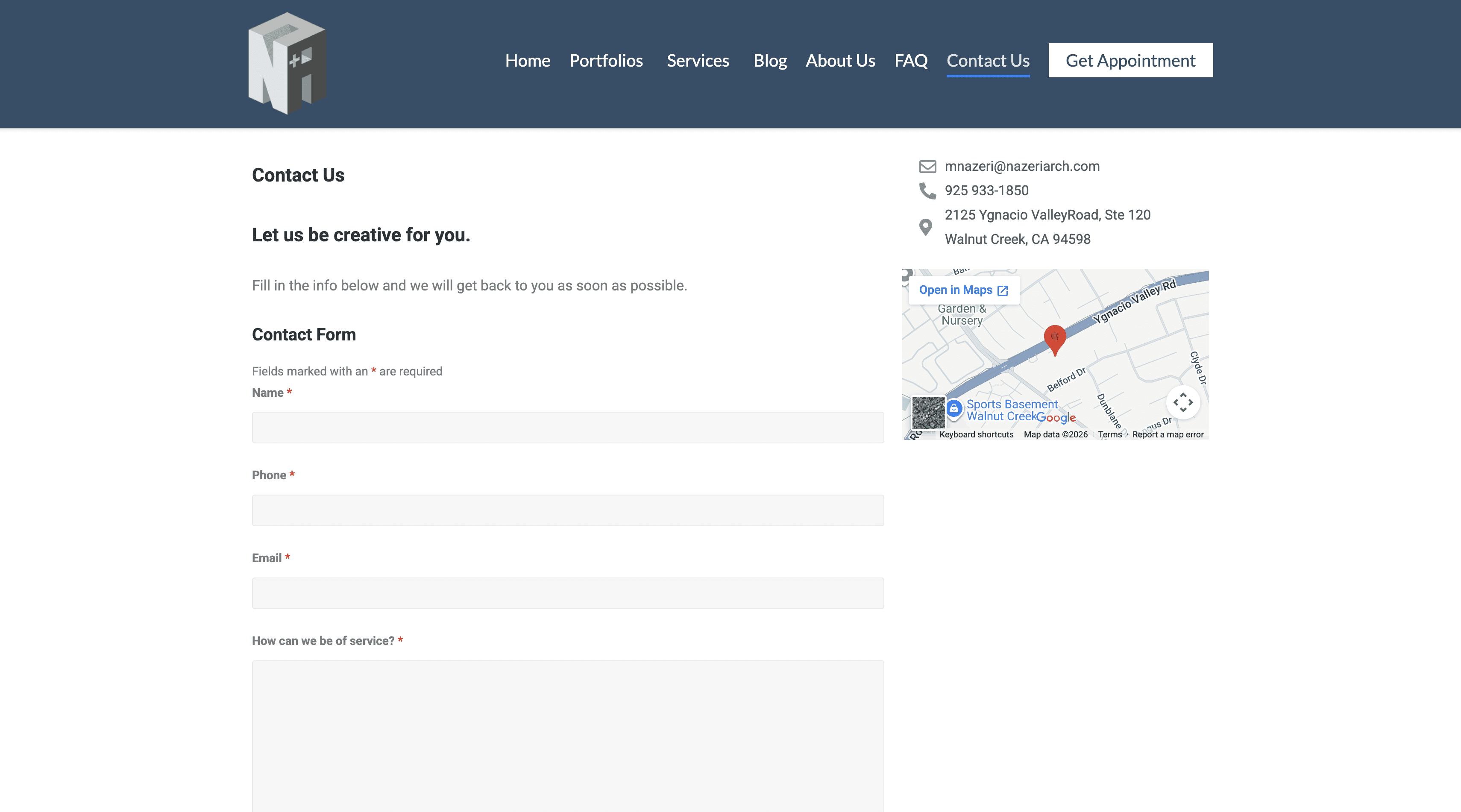
Contact page divided
Before
One generic form for everyone. No context, no next steps — felt like a commitment.
After
Two separate forms tailored to where the user is in their decision. Shifts the feeling from "contact us" to "start a conversation."
4
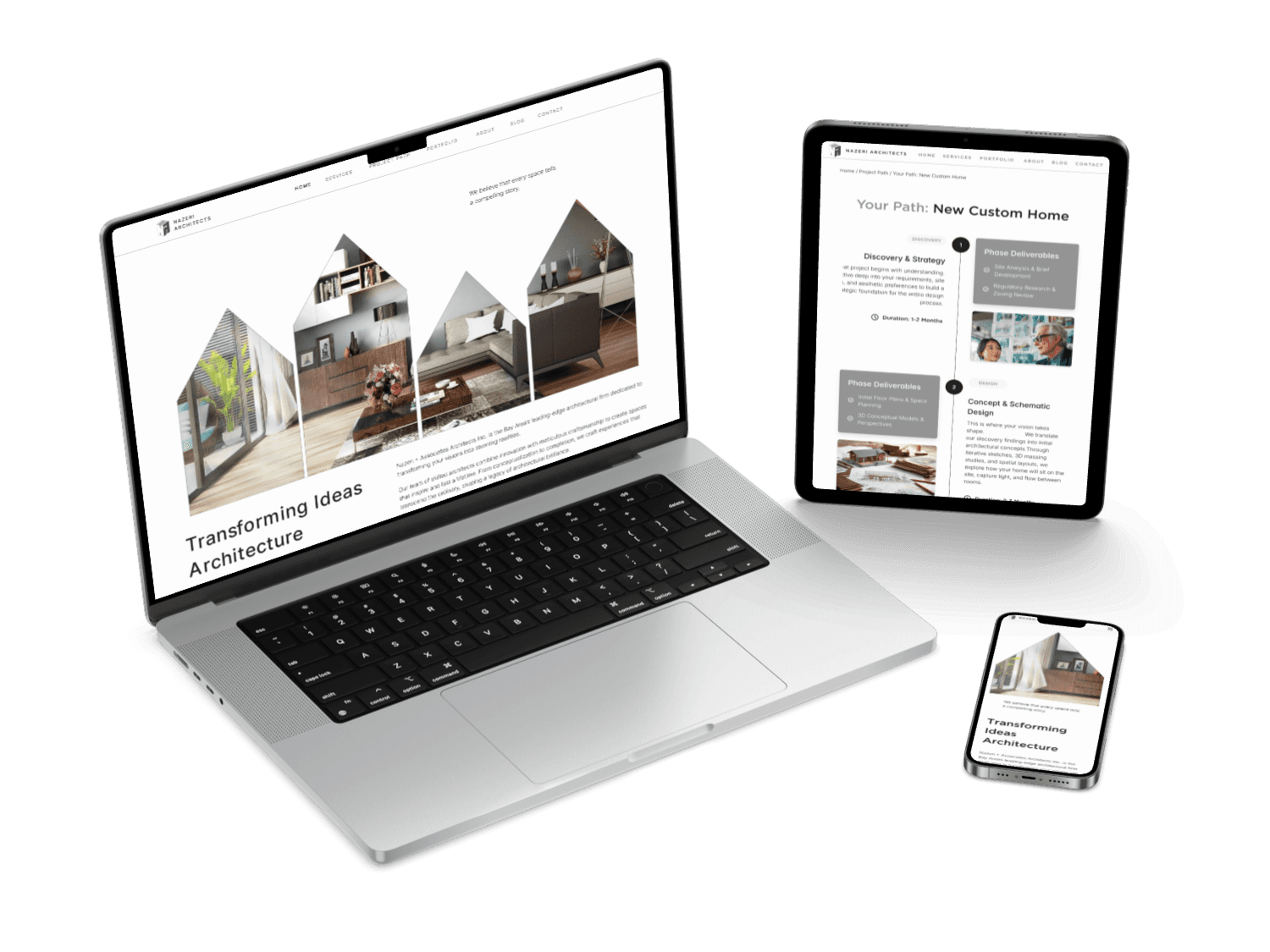
Mobile as a trust signal
Before
There were practically no responsiveness for tablet and phone versions.
After
Fully responsive from wide screen to phone.
Desktop
Tablet
Phone
To take a look at the full version of Nazeri Architects here.

TRADE-OFFS
Deprioritized aggressive above-the-fold CTAs in favor of education-first scrolling journeys.
Deprioritized visual spectacle (large format imagery only) in favor of content-rich project narratives.
Deprioritized a one-size-fits-all experience in favor of a slightly more complex segmented architecture.
TAKEAWAYS
Impact
Both personas now have a clear, relevant path through the site without anxiety or information overload.
The "Educate First" model directly addresses silent drop-off — a user who understands the process before contacting is a more qualified lead. The redesign doesn't just reduce anxiety — it filters intent, which improves the quality of every inquiry the firm receives.
Removes the credibility gap between the firm's strong portfolio and its weak digital presence.
What I Learned
The biggest shift in my thinking was realizing that the contact form wasn't the problem. The lack of information before it was. Once I reframed the goal from "get users to contact" to "get users ready to contact," every design decision became clearer.
I also learned that process transparency is a form of trust. Users don't just want to see good work — they want to understand what working with you actually feels like before they commit to finding out.
I'd run real user interviews before finalizing personas — my research was entirely secondary and competitive, which limits confidence in the decisions.
I'd also test the path split early. It was the highest-risk decision and I built everything around it without validation.
I'd define success metrics with the firm upfront — time on site, contact form conversion, path completion. Without a baseline, the impact of the redesign stays qualitative.
Next Steps
User test the Residential / Commercial path split with real homeowners and local business owners in the Walnut Creek area.
Add a consultation scheduling tool to replace the static contact form, with clear response time expectations from the firm.
Work with CEO to create a more personal About page — client testimonials tied to specific project types, not just generic praise
c
2026
Hanna Smolich